

AI Isn’t the Enemy, Irresponsible Use Is
Artificial Intelligence has quickly become one of the most debated topics in business and society. Depending on who you ask, AI is either the greatest productivity breakthrough of our generation or a dangerous threat to jobs, privacy, and the environment. I believe both perspectives hold some truth, and with strict guidelines and security measures, we can harness its benefits while minimizing its risks.
Concerns around AI typically fall into three categories:
- Security and privacy risks
- Environmental impact from large-scale computing
- Fear of job displacement
These concerns should be addressed, but the real risk is not AI. It is using AI without intention, boundaries, or accountability.
AI is here to stay – it’s built into almost every technology tool and app we use – and wishing it away won’t solve anything. I believe the conversation we should be having is this: “How do we use AI responsibly in ways that advance the greater good?”
A Framework for Productive AI Use: The A.I.M. Model™
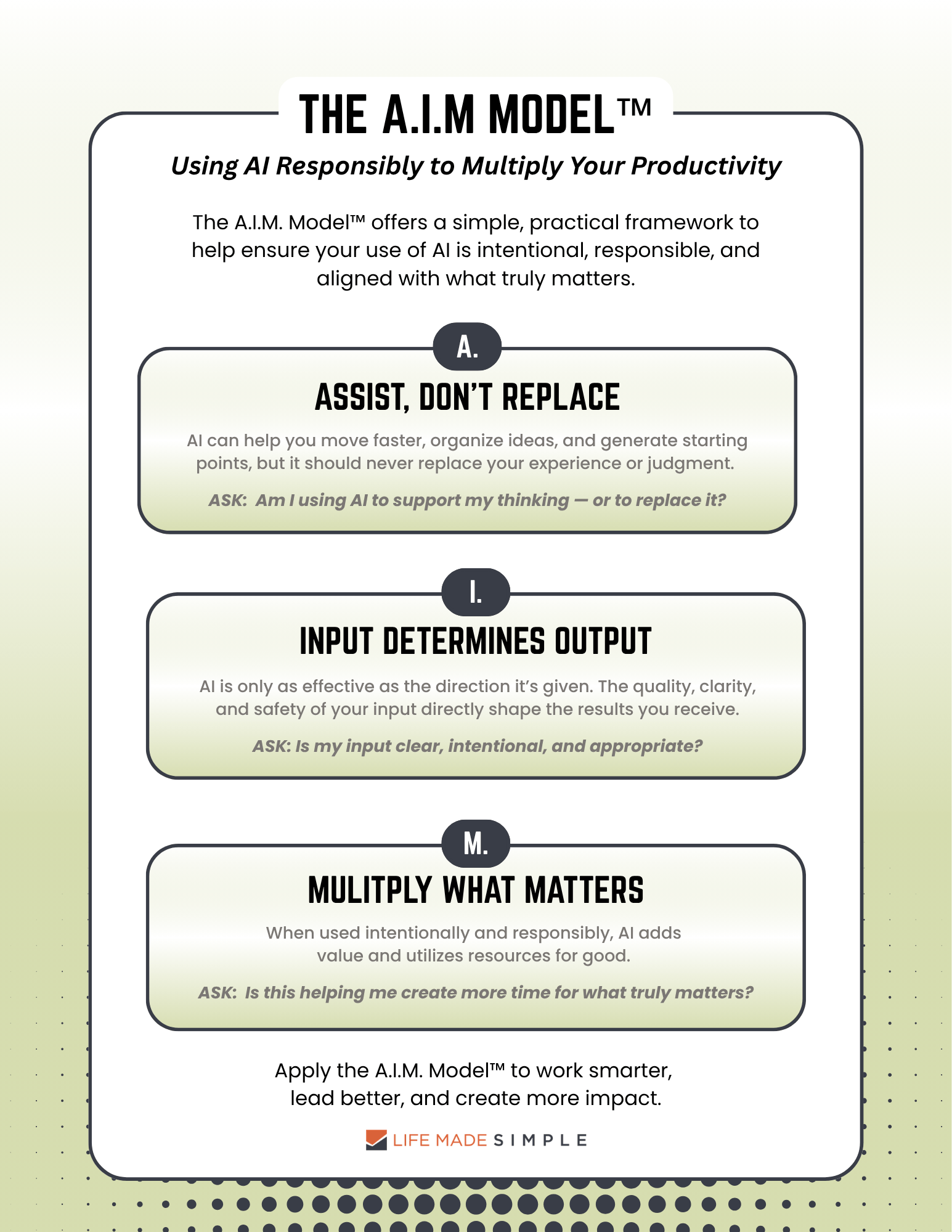
The responsible use of AI may feel like a big, global issue, but it starts with how each of us chooses to use it every day. The A.I.M. Model™ offers a simple, practical framework to help ensure your use of AI is intentional, responsible, and aligned with what truly matters.
A — Assist, Don’t Replace
AI should support your thinking, not take it over. It can help you move faster, organize ideas, and generate starting points, but it should never replace your experience or judgment. AI is just one tool in your decision-making tool chest.
I recently received an email from someone suggesting I check out “a quick AI prototype” based on the ART™ methodology I use with clients. I was intrigued, and so I tried it out. What I found was that it took much more time to prompt and run this AI prototype to assist with the Action-Reference-Toss decisions than it would to make the decisions myself (which goes completely against the purpose of ART™ – a tool to help make information workflow decisions quick and simple!)
AI will not always be the better solution, and we shouldn’t use it just because it’s there. As I recommend with any goal, define the need and your vision for a successful result, and then determine if AI can be a helpful resource to reach that goal.
I — Input Determines Output
AI is only as effective as the direction it’s given. The quality, clarity, and safety of your input directly shape the results you receive. This means two things:
- Be intentional with what you ask. Clear prompts lead to better outcomes.
- Be mindful of what you share. Know how your AI platforms use your information. Protecting sensitive information ensures safety and confidentiality.
Spending some time upfront to craft the best prompts will save time, resources, and frustration in the long-run.
M — Multiply What Matters
The true value of AI is not in doing more but in creating space for what matters most. When used intentionally and responsibly, AI adds value and utilizes resources for good. It also frees up time for more valuable, meaningful activities such as relationships, creativity, leadership, and strategic thinking.
It’s easy to fall into the trap of using your trusted chatbot for the latest trends, and I admit sometimes it can be fun. Like many of you, I also asked my AI assistant to “generate a caricature of me based on what you know about me so far.” But now that I know more, I realize it was not an intentional, responsible use of AI. While it was fun for a minute, it did not add value to myself or others and definitely did not improve my productivity. I was “doing more” for no good reason and wasting valuable resources at the same time.
I also find myself continuing in AI chats longer than I need to, even after I’ve achieved what I set out to do – it’s the chatbot version of “rabbit holes.” Most AI tools love these additional “value add” statements when answering your initial request: “If you want, I can also….” Before responding “Sure!”, pause to determine whether the extra time and energy are worthwhile.
The next time you open up ChatGPT, Claude, or Copilot, run through the A.I.M. Model™ as a guide to ensure your use of AI is both intentional and responsible.
Click below for a 1-page printable of the A.I.M. Model™
Send download link to:
Responsible AI Use Within Business
If we take AI use a step further, we can look at how it shows up within organizations. Responsible AI isn’t just about the tools a company adopts, but about the culture it creates around how those tools are used. Leaders in this space recognize that AI should enhance their people and processes, and not replace accountability or judgment.
A responsible AI culture includes:
- Clear usage guidelines
Define expectations for how AI should (and should not) be used within the organization. - Employee training and skill development
Teams should be equipped with the knowledge and confidence to use AI effectively and responsibly. - Transparency with clients and stakeholders
Build trust by being open about when and how AI is used. - Ethical boundaries
Establish guardrails to prevent misuse. - Ongoing human oversight
Ensure that people remain accountable for decisions, outcomes, and quality.
The companies that will benefit most, internally and in their broader impact, are those that use AI intentionally and consistently apply these principles.
AI Provides An Opportunity We Shouldn’t Ignore
We are living through a shift similar to the arrival of the internet, smartphones, and social media. Those who resist will be left behind. Those who adopt recklessly will create problems. But if used the right way, AI offers an extraordinary opportunity to expand human capacity without expanding human hours.
The question is no longer whether AI will exist in our homes and workplaces – it’s here to stay. Like every transformative tool throughout history, its impact depends entirely on how humans choose to use it.
Additional AI Resources
As I was writing and refining this piece, I came across a few thoughtful perspectives on AI that you may find helpful:
- “I’m sick of hearing about AI, but I also can’t stop using it”: by Chris Bailey, Productivity Thought Leader and Author of Intentional, The Productivity Project, and more
- The AI Doc: Or How I Became an Apocaloptimist: Told through the perspective of filmmaker Daniel Roher as he prepares to become a father, the film investigates the existential threats and potential promises of artificial intelligence. (from Wikipedia)
- WorkEAI.com, Mazen Arawi works with you and your business to create an intentional and responsible plan for integrating AI into your business
Recent Comments