
by Lori Vande Krol | Apr 2, 2026 | General Productivity, Team Productivity, Technology, Tools
Artificial Intelligence has quickly become one of the most debated topics in business and society. Depending on who you ask, AI is either the greatest productivity breakthrough of our generation or a dangerous threat to jobs, privacy, and the environment. I believe both perspectives hold some truth, and with strict guidelines and security measures, we can harness its benefits while minimizing its risks.
Concerns around AI typically fall into three categories:
- Security and privacy risks
- Environmental impact from large-scale computing
- Fear of job displacement
These concerns should be addressed, but the real risk is not AI. It is using AI without intention, boundaries, or accountability.
AI is here to stay – it’s built into almost every technology tool and app we use – and wishing it away won’t solve anything. I believe the conversation we should be having is this: “How do we use AI responsibly in ways that advance the greater good?”
A Framework for Productive AI Use: The A.I.M. Model™
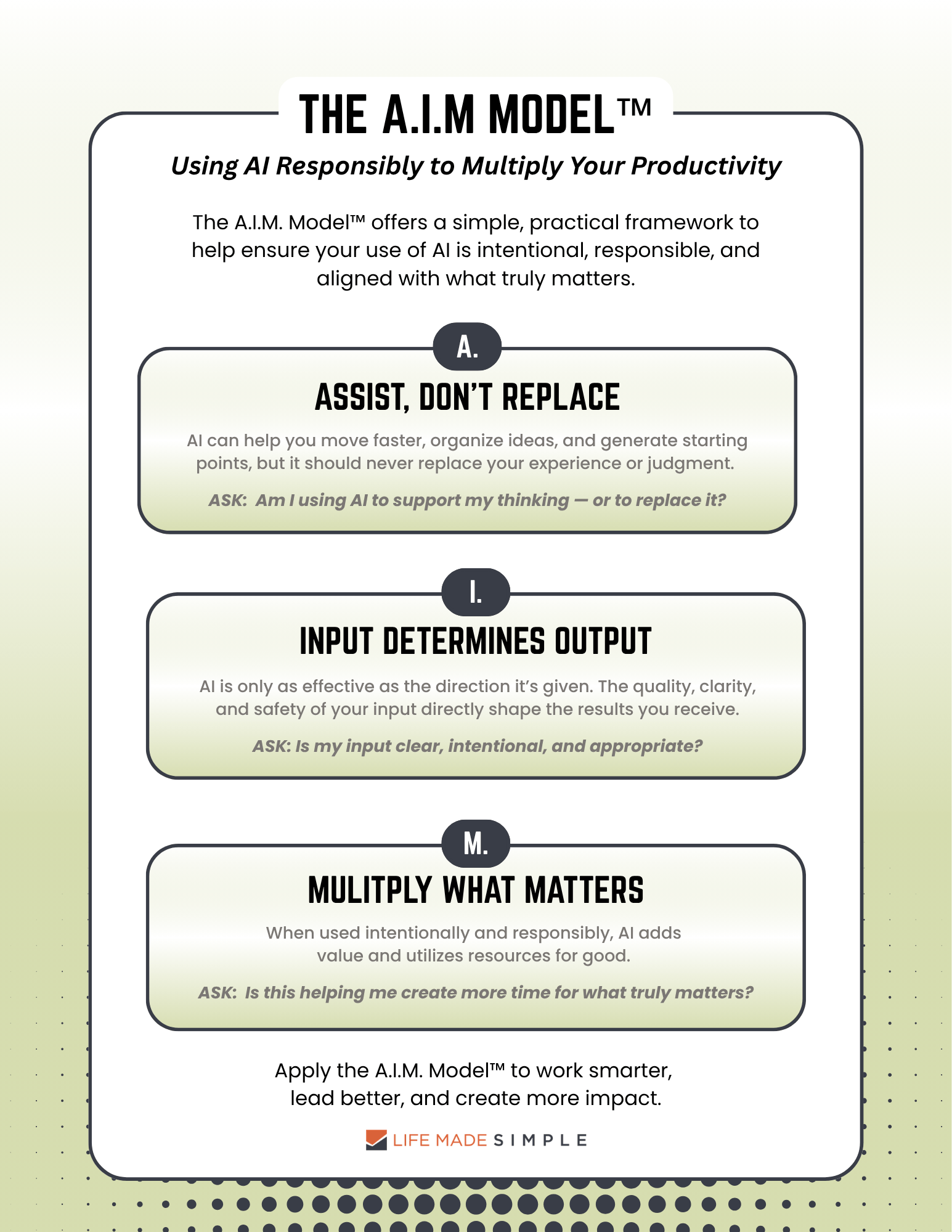
The responsible use of AI may feel like a big, global issue, but it starts with how each of us chooses to use it every day. The A.I.M. Model™ offers a simple, practical framework to help ensure your use of AI is intentional, responsible, and aligned with what truly matters.
A — Assist, Don’t Replace
AI should support your thinking, not take it over. It can help you move faster, organize ideas, and generate starting points, but it should never replace your experience or judgment. AI is just one tool in your decision-making tool chest.
I recently received an email from someone suggesting I check out “a quick AI prototype” based on the ART™ methodology I use with clients. I was intrigued, and so I tried it out. What I found was that it took much more time to prompt and run this AI prototype to assist with the Action-Reference-Toss decisions than it would to make the decisions myself (which goes completely against the purpose of ART™ – a tool to help make information workflow decisions quick and simple!)
AI will not always be the better solution, and we shouldn’t use it just because it’s there. As I recommend with any goal, define the need and your vision for a successful result, and then determine if AI can be a helpful resource to reach that goal.
I — Input Determines Output
AI is only as effective as the direction it’s given. The quality, clarity, and safety of your input directly shape the results you receive. This means two things:
- Be intentional with what you ask. Clear prompts lead to better outcomes.
- Be mindful of what you share. Know how your AI platforms use your information. Protecting sensitive information ensures safety and confidentiality.
Spending some time upfront to craft the best prompts will save time, resources, and frustration in the long-run.
M — Multiply What Matters
The true value of AI is not in doing more but in creating space for what matters most. When used intentionally and responsibly, AI adds value and utilizes resources for good. It also frees up time for more valuable, meaningful activities such as relationships, creativity, leadership, and strategic thinking.
It’s easy to fall into the trap of using your trusted chatbot for the latest trends, and I admit sometimes it can be fun. Like many of you, I also asked my AI assistant to “generate a caricature of me based on what you know about me so far.” But now that I know more, I realize it was not an intentional, responsible use of AI. While it was fun for a minute, it did not add value to myself or others and definitely did not improve my productivity. I was “doing more” for no good reason and wasting valuable resources at the same time.
I also find myself continuing in AI chats longer than I need to, even after I’ve achieved what I set out to do – it’s the chatbot version of “rabbit holes.” Most AI tools love these additional “value add” statements when answering your initial request: “If you want, I can also….” Before responding “Sure!”, pause to determine whether the extra time and energy are worthwhile.
The next time you open up ChatGPT, Claude, or Copilot, run through the A.I.M. Model™ as a guide to ensure your use of AI is both intentional and responsible.
Click below for a 1-page printable of the A.I.M. Model™
Responsible AI Use Within Business
If we take AI use a step further, we can look at how it shows up within organizations. Responsible AI isn’t just about the tools a company adopts, but about the culture it creates around how those tools are used. Leaders in this space recognize that AI should enhance their people and processes, and not replace accountability or judgment.
A responsible AI culture includes:
- Clear usage guidelines
Define expectations for how AI should (and should not) be used within the organization.
- Employee training and skill development
Teams should be equipped with the knowledge and confidence to use AI effectively and responsibly.
- Transparency with clients and stakeholders
Build trust by being open about when and how AI is used.
- Ethical boundaries
Establish guardrails to prevent misuse.
- Ongoing human oversight
Ensure that people remain accountable for decisions, outcomes, and quality.
The companies that will benefit most, internally and in their broader impact, are those that use AI intentionally and consistently apply these principles.
AI Provides An Opportunity We Shouldn’t Ignore
We are living through a shift similar to the arrival of the internet, smartphones, and social media. Those who resist will be left behind. Those who adopt recklessly will create problems. But if used the right way, AI offers an extraordinary opportunity to expand human capacity without expanding human hours.
The question is no longer whether AI will exist in our homes and workplaces – it’s here to stay. Like every transformative tool throughout history, its impact depends entirely on how humans choose to use it.
Additional AI Resources
As I was writing and refining this piece, I came across a few thoughtful perspectives on AI that you may find helpful:

by Lori Vande Krol | Nov 6, 2025 | General Productivity, Goals and Priorities, Habits, Technology, Time Management, Tools
If you’ve seen the film The Social Dilemma on Netflix, you know how deliberately social media is engineered to keep us hooked. (If you haven’t, I recommend watching it!) Every like, notification, and reel is designed to capture and keep your attention—often without you even realizing it.
The good news? You can reclaim your time and attention, but it may take more than willpower alone to break the addictive hold our phones have on us. Here I share seven apps and tools to help you spend less time on your phone, allowing more time for what matters most.
Start with the Built-In Tools You Already Have
1. Digital Wellbeing (Android) / Screen Time (iOS)
What it does: Track and limit your screen time.
How it works: You can find these built-in tools in your settings. Both show exactly how much time you’re spending on every app. You can set daily limits for apps like Facebook or TikTok, and schedule times of day when apps are blocked.
Who it’s great for: Anyone who wants to monitor behavior, set boundaries, and make intentional adjustments without downloading anything extra.
Links: Digital Wellbeing / Screen Time
Add Downloadable Apps for Extra Support
2. Forest
What it does: Stay focused by growing virtual trees.
How it works: Every time you want to focus, you plant a tree. Leave the app to check Instagram or TikTok, and the tree dies. Over time, you’ll grow an entire forest representing your focused hours.
Who it’s great for: Visual learners and anyone motivated by gamification.
Link: Forest
3. Freedom
What it does: Block distracting apps and websites.
How it works: Schedule focus sessions across all your devices to block apps, websites, or even the entire internet if you want deep work time.
Who it’s great for: People who need cross-device control and serious focus sessions.
Link: Freedom
4. One Sec
What it does: Interrupt impulsive app openings.
How it works: Adds a short pause before opening apps —just long enough to ask yourself, “Do I really want to do this?”
Who it’s great for: Increasing intentionality by breaking the habit loop of compulsive checking.
Link: one sec
5. StayFree
What it does: Detailed app usage tracking and blocking across devices.
How it works: Offers insights into your usage patterns and allows you to set daily limits, block full apps, or certain features within apps. You can set reminders for when you’re approaching your limit. It can also give you a gentle pause or notification before you begin scrolling without thinking.
Who it’s great for: Users who want more granular control and analytics across devices.
Link: StayFree
6. Flipd
What it does: Tracks your productivity, boosts your motivation, and connects you with communities.
How it works: “Flip off” distracting apps for a set period, or schedule recurring focus sessions. You can also track your time and celebrate milestones. Connect with communities related to wellness, school, and more.
Who it’s great for: Students, professionals, or anyone who needs extra accountability.
Link: Flipd
7. Unpluq
What it does: Cultivates mindful phone use.
How it works: Uses a tag, or “key,” to unlock apps that you have chosen to block.
Who it’s great for: Those who want that extra control and intention of having to step away from their phone before unlocking apps. Also great to limit kids’ phone time.
Link: Unpluq
Practical Tips for Limiting Social Media
In addition to using supportive tools, here are some daily habits that can help reduce the pull your phone has on you:
- Schedule your scroll time: Instead of opening your phone whenever, block out specific times to check in on texts and messages.
- Set daily app limits: Decide ahead of time how much phone time is reasonable per day. Step away when you hit that limit.
- Batch notifications: Turn off non-essential alerts so you’re not constantly pulled to your phone and potentially back into feeds.
- Phone-free zones: Keep your bedroom, dinner table, or work area free from phones and apps. Out of sight = out of mind.
- Go analog: Use analog alternatives when possible (planners, journals, books, clocks).
Reducing screen time isn’t about restriction—it’s about reclaiming your attention and living intentionally. Start with the tools already on your phone, then layer in apps that support focus, mindfulness, and accountability. With the right combination, you can take back control and make technology work for you.

by Lori Vande Krol | Sep 11, 2025 | General Productivity, Goals and Priorities, Habits, Planning, Time Management, Tools
Do you ever feel like you’re spinning your wheels—busy all day but never quite moving forward? Many of my clients come to me for exactly that reason: they’re craving structure in their personal and work lives that feels supportive but not stifling, and they don’t know where to start. The key is to create a schedule built from habits and routines that support your priorities. It sounds simple, but creating your ideal schedule takes more intention than you might think.
First, Get Clear on Your Priorities
Whenever I begin work with a client, we spend time defining or reviewing their Mission, Vision, and Goals – the first 3 steps in the ProAction Process™. Without this, it is difficult to know which habits and routines will move you towards happiness and success. Once the priorities are clear, and we have a basis for what’s most important, we can then dive into the fun stuff – creating the structured schedule. And, the first action towards determining an ideal, supportive schedule is to define habits and routines.
Define Your Habits
Think of habits as the puzzle pieces towards reaching your goals and creating your vision. Once you are clear on your priorities, these puzzle pieces will fall into place. You can then more easily define which habits you want to cultivate—and how often you want them to show up—then you can stack them into daily routines and weekly rhythms that feel natural. Before you know it, your vision will start to form. Without that clarity, plans and schedules can end up overcomplicated, overwhelming, or unsustainable.
The Habits Frequency Framework
To help my clients get clear on their habits, I use a simple framework. It breaks habits down into four categories based on frequency:
- Daily – the habits you want to anchor your day with (e.g., journaling, exercise, reading)
- Weekly – the habits that keep work and life on track but don’t need daily attention (e.g., team check-ins, sales calls, meal planning, phone call to Mom)
- Monthly – the habits that add intentionality and prevent things from piling up (e.g., filing/scanning, reviewing goals, networking events, date night)
- Annually – the habits that create traditions, resets, and big-picture reflection (e.g., yearly retreat, tax prep, mission and vision refresh, holiday party)
This frequency-based approach makes habits feel less like a mountain to climb and more like the puzzle pieces you can place where they fit best.
I recently worked with a client, Lilly, who was overwhelmed with work and life. She was working nights and weekends just to keep up, barely seeing her family, and she never felt like she could get ahead and look forward. After clarifying Lilly’s priorities, we determined that she was trying to do too many things. She pared back her focus and built habits and routines to support her current, highest priority goals. By defining a habit to review and reset her goals (quarterly and annually), Lilly became more comfortable letting other projects and tasks wait.
Her shorter-term habits (daily, weekly, monthly) were then focused on actions that supported her more immediate goals and priorities…like attending 2 events per month that targeted a specific client-base, blocking time each week to finish her e-book, setting aside time on Sundays to meal plan, scheduling a family outing once per month, and getting to bed earlier every day.
Click below to grab the simple, fillable template I use with clients to map habits by frequency—it’s the perfect first step to designing your own ideal schedule.
Habit Building Template
FREE DOWNLOAD
Build Your Routines and Schedule Them
Once your habit list feels right, it’s time to build routines and schedule them. Daily habits shape your beginning of day and end of day flows. Weekly ones find their home on specific days. Monthly habits might get anchored to a certain date each month. Annual habits can be tied to seasons, months, or meaningful dates.
Once Lilly blocked time for her defined habits and routines, she could more clearly see what her ideal week looked like. She could structure her schedule in a way that allowed her to focus on her current priorities and meet her goal of no-work evenings and weekends. As she developed these habits and worked more intentionally, she felt more accomplished each week – even though she was working less hours.
When your habits are placed with intention and support your mission, vision, and goals, your routines will feel less like rigid rules and more like a supportive rhythm that carries you forward.
Final Thought
Remember: structure doesn’t create habits—habits create structure. Get clear on your priorities, and let your habits build the structure that supports your most productive (and enjoyable) life. So, grab the template and begin mapping out your habits today—your future self will thank you.

by Lori Vande Krol | May 12, 2025 | General Productivity, Habits, Motivation, Organization
I was recently quoted in an article on Redfin about how to get and stay motivated to clean your home. While home cleaning isn’t the focus of my business, the strategies I shared tie directly into the work I do every day with clients—helping them build sustainable systems for managing their time, space, and information.
Whether you’re tackling clutter on your kitchen counter or digital chaos in your inbox, the key to success is the same: consistent, manageable habits. It’s not as much about the task itself, but the habit of taking intentional action that creates lasting change. The best way to ensure intentional action is by scheduling those habits and routines into your weeks and days.
You can read the full article, and learn more expert tips for a tidier, calmer home, here: https://www.redfin.com/blog/how-to-stay-motivated-to-clean/

Recent Comments